
Table of Contents
Tired of Paying Too Much for TV You Don’t Even Watch?
Let’s be honest — most of us have been there. You’re staring at a cable bill that somehow jumped to $180 a month, and half those channels you’re paying for? You haven’t touched them in years. Meanwhile, the shows and sports you actually want to watch seem to be scattered across five different streaming apps.
Sound familiar?
That’s exactly why millions of Americans are making the switch to IPTV in 2026. And if you’re reading this, you’re probably wondering: Is it really worth it? How do I find the best IPTV service? And how do I make sure I’m doing it the right way?
You’re in the right place. In this guide, we’re breaking down everything you need to know — from what IPTV actually is, to how to spot a quality legal IPTV subscription, to what real US users are saying. We’ll even tell you how to try it out completely free before spending a single dollar.
Let’s get into it.
What Is IPTV and Why Are Americans Switching in 2026?
IPTV stands for Internet Protocol Television — but forget the technical jargon. Think of it like this: instead of receiving TV channels through a cable wire or a satellite dish on your roof, you’re getting them delivered over your internet connection. Same channels, same live content, same sports — just through a smarter, more flexible pipe.
The best way to picture it? Imagine your local library. Old-school cable is like driving to the library, picking from whatever books they happen to have on the shelf that day, and paying a flat fee whether you read one book or a hundred. IPTV is more like having that entire library delivered to your door, on-demand, on any device you own.
It’s no surprise that cord-cutting has been exploding across the US. In 2026, more households than ever are ditching traditional cable — and a growing number are turning to IPTV subscriptions as their primary TV solution. The combination of lower costs, more flexibility, and access to live content (including local news and sports) makes it a genuinely compelling alternative.
What Makes a Great IPTV Subscription in 2026?
Not all IPTV services are created equal. If you’ve poked around online, you already know there’s a wild range of options out there — some excellent, some that’ll leave you frustrated on a Sunday afternoon when you’re trying to watch the game. Here’s what separates the best from the rest.
Channel Selection and US-Specific Content
This one matters more than most people realize. A solid IPTV subscription should give you access to major US broadcast networks, local channels by region, popular cable networks, and premium sports packages. If you’re in the 35–75 age range, chances are you want reliable access to news channels, classic TV, live sports, and maybe a few of your regional favorites.
Look for a service that offers at least 10,000+ channels and provides a solid lineup of US-based content — not just a massive international catalog that buries American programming.
Streaming Quality and Reliability
A service might advertise thousands of channels, but if the stream freezes during the fourth quarter or pixelates every time there’s a storm, that’s a dealbreaker. The best IPTV services in 2026 offer HD and 4K streams with minimal buffering, especially during peak hours like evenings and weekends.
Ask yourself: does the service have redundant servers? Do they offer anti-freeze technology? These technical features make a real difference in your daily viewing experience.
Device Compatibility
One of the big advantages of IPTV over cable is that it works across all your devices. Your smart TV, Amazon Fire Stick, Roku, smartphone, tablet, laptop — a good IPTV service should work seamlessly across all of them. For households with multiple viewers and multiple screens, this is a huge plus.
Customer Support
This is where many IPTV services fall short. When something goes wrong — and occasionally, something will — you want to be able to reach a real support team quickly. Look for services that offer 24/7 live chat or support ticketing, and check what real customers say about their response times.
Best Legal IPTV Subscription — What to Look For (and What to Avoid)
This is probably the question we get asked most often: Is IPTV legal?
The short answer is: it depends entirely on the service.
There are plenty of legitimate, legal IPTV services operating in the US that license their content properly and comply with broadcasting regulations. These are the services you want. Then there are gray-market or outright illegal providers that stream pirated content — and beyond the legal risk to you, the quality is usually unreliable and the services disappear overnight without warning.
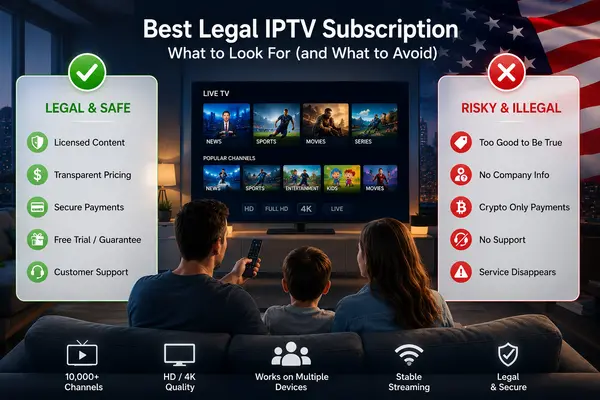
Signs of a legitimate, legal IPTV service:
- Transparent pricing with no hidden fees
- Clear terms of service and a real company behind it
- Proper billing (credit card, PayPal — not just cryptocurrency)
- A free trial or money-back guarantee
- Responsive customer support
Red flags to watch out for:
- Prices that seem impossibly cheap (think $5/month for 20,000 channels)
- No verifiable company information or contact details
- Payment only accepted in crypto or wire transfer
- No customer support channel
When you find a provider that ticks the right boxes, a quality legal IPTV subscription in 2026 typically runs between $15 and $40 per month depending on the package — comparable to or less than a single streaming service, but with live TV included.
IPTV USA Review — What Real Users Are Saying
Across the US, IPTV adoption has been growing steadily among viewers in the 35–75 demographic — and the feedback tells a pretty consistent story.
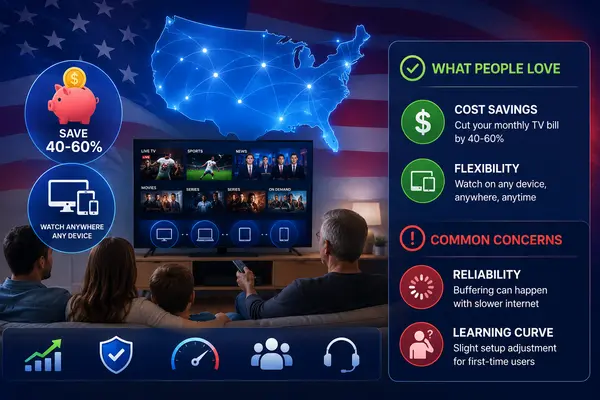
What people love most:
The number one thing users rave about is cost savings. Once people make the switch, many report cutting their monthly TV bill by 40–60% compared to traditional cable. That’s real money — often $80 or more per month back in your pocket.
The second big win is flexibility. Being able to watch your content on any device, anywhere — on your TV at home, on your tablet at the kitchen table, or on your phone while traveling — resonates especially with viewers who have family members in different parts of the country. You’re not locked to one screen or one room.
Common concerns:
The main hesitation people express is reliability. Some newer IPTV users have experienced buffering issues, particularly if their home internet speeds are on the slower side (we’ll cover the ideal setup in a moment). This is usually easy to fix with the right setup.
A smaller group of users mention the learning curve of getting IPTV set up for the first time. If you’ve been on cable your whole life, there is a slight adjustment — but most people find it straightforward once they get going, and the best services offer setup guides and live support to walk you through it.
Free Trials — How to Test Before You Commit
Here’s the good news: you don’t have to take anyone’s word for it — including ours.
We offer a free trial so you can experience the service firsthand before making any commitment. This is honestly the best way to evaluate any IPTV service. No contracts, no pressure — just a genuine chance to see if it works for your household.
How to Choose the Right IPTV Plan for Your Household
Everyone’s situation is a little different. Here’s a simple step-by-step approach to finding the right fit:
Step 1: Know what you actually watch. Make a quick list — sports channels, news networks, entertainment, international content? This tells you which tier or package you actually need, so you’re not paying for channels you’ll never use.
Step 2: Count your screens. How many people in your household want to watch, and on how many devices at once? Most quality services offer multi-connection plans (1, 2, or 3 simultaneous connections). A couple watching separately in different rooms needs a 2-connection plan at minimum.
Step 3: Check your internet speed. IPTV works best with a stable connection. For standard HD streaming, you’ll want at least 25 Mbps. For 4K content or multiple simultaneous streams, aim for 50 Mbps or higher. Most modern home internet plans in the US exceed these thresholds easily.
Step 4: Consider a monthly vs. annual plan. Many IPTV services offer significant savings when you pay for 3, 6, or 12 months upfront. Once you’ve tested the service and you’re happy, locking in a longer plan can save you 30–50% compared to month-to-month pricing.
Step 5: Start with the free trial. Always test before you buy. Use the trial to confirm the service works well in your home before committing to any paid plan.
People Also Ask
Is IPTV legal in the US?
Yes — legal IPTV services that properly license their content are completely legal in the US. The key is choosing a provider that operates transparently, with licensed content and clear terms of service. Avoid services that seem suspiciously cheap or lack basic company information, as these are more likely to be operating illegally.
What devices work with IPTV?
Most modern IPTV services are compatible with a wide range of devices including Smart TVs (Samsung, LG, etc.), Amazon Fire TV Stick, Roku, Apple TV, Android boxes, iOS and Android smartphones and tablets, and desktop browsers. Always verify device compatibility before subscribing.
Can I watch live sports on IPTV?
Yes, and this is one of the biggest draws for many US viewers. Quality IPTV services carry major sports networks and offer live coverage of NFL, NBA, MLB, NHL, college sports, and more. Some services also include international sports like soccer and cricket — a big plus if you have roots outside the US.
What’s the difference between IPTV and regular streaming?
Regular streaming services (like the big names you already know) typically offer on-demand content without live TV. IPTV delivers live television channels — essentially everything cable TV offers — over the internet. Many IPTV services also include video-on-demand libraries, giving you the best of both worlds.
The Bottom Line on the Best IPTV Service 2026
The landscape for TV has changed dramatically, and in 2026, there’s really no reason to keep overpaying for a cable bundle stuffed with channels you don’t want. IPTV gives you the live television experience you’re used to — local channels, sports, news, entertainment — at a fraction of the cost, with the flexibility to watch on your terms.
The key is choosing the right provider: one that’s legal, reliable, and backed by real customer support. Do your homework, look for the qualities we’ve outlined above, and above all — take advantage of the free trial before you commit.
There’s no better way to know if a service is right for you than to experience it firsthand in your own home, on your own devices, watching the content you actually care about.
Ready to see what you’ve been missing? Start your free trial today — no credit card required, no strings attached. Your cable company won’t be happy about it, but your wallet will be.