
Table of Contents
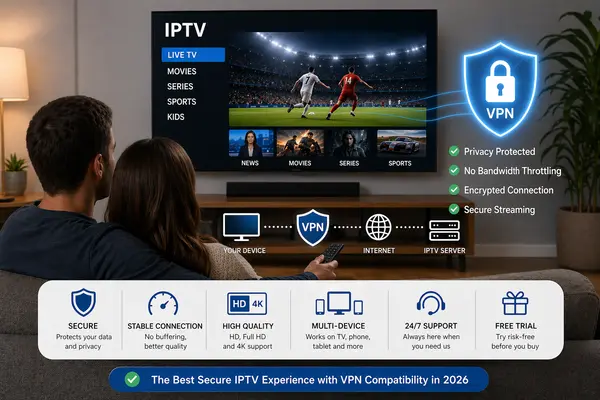
The best secure IPTV experience in 2026 is one where your stream is stable, your data is protected, and your internet provider cannot interfere with your connection. If you have ever noticed your video quality drop during peak hours, or wondered who can see what you are watching online, those are the exact problems a secure IPTV setup with VPN compatibility is designed to solve.
This guide walks you through what genuinely secure IPTV looks like, how a VPN fits into your streaming setup, and what to look for when choosing the best IPTV subscription in 2026. Whether you are streaming on a Fire TV Stick, a Smart TV, or an Android box, everything here applies to everyday US viewers aged 35 and up. And if you want to try things out first, a free trial is available with no commitment required.
Why Security Matters When You Stream IPTV
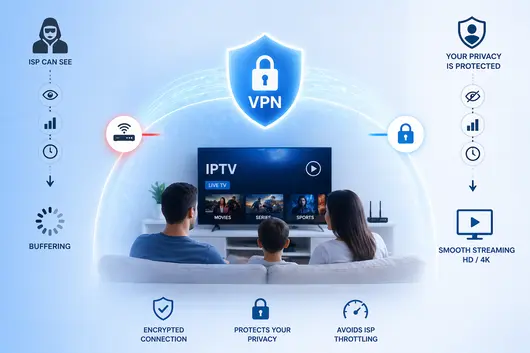
Most people assume watching TV online is a private activity. Without proper protection, it is not. Your internet provider can see which services you connect to, how long you stream, and how much bandwidth you use. In the US, ISPs are legally permitted to collect and sell this kind of data.
There is also the throttling problem. When an ISP detects heavy video streaming on your line, it can deliberately slow your connection down. This is why a perfectly good internet plan sometimes delivers stuttery, pixelated video during prime time. A best secure IPTV setup routes your traffic through an encrypted connection, making it much harder for your ISP to identify and slow down your streaming activity.
Protecting your privacy while streaming is not about doing anything unusual. It is simply a sensible habit, the same way locking your front door makes sense even in a quiet neighborhood.
What Makes an IPTV Service Truly Secure
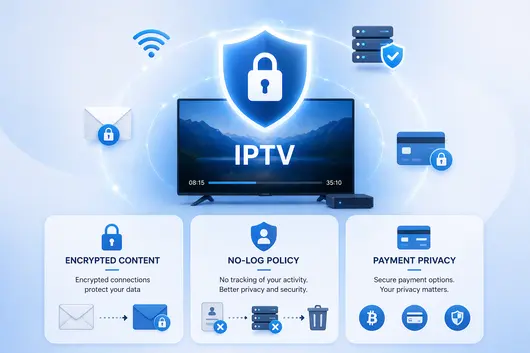
Not every provider that claims to be secure actually is. Here is what to look for.
Encrypted Content Delivery
A best secure IPTV provider transmits content over encrypted connections, typically HTTPS-based delivery, so the data traveling to your device cannot easily be intercepted. An unencrypted stream is like sending a postcard: anyone along the route can read it. An encrypted stream seals that content in an envelope.
No-Log Policy and Server Quality
A trustworthy IPTV subscription service provider does not keep records of what you watched, when, or from which IP address. This is called a no-log policy, and it matters because logs can be hacked, subpoenaed, or misused. The quality of the provider’s server infrastructure also plays a role: dedicated, well-maintained servers are more stable and less likely to expose user data through technical gaps.
Payment Privacy
A genuinely secure provider gives you payment options that do not require unnecessary personal information. Cryptocurrency, prepaid cards, or privacy-friendly processors are worth looking for if anonymity matters to you.
How VPN Compatibility Works with IPTV
A VPN encrypts your internet traffic and routes it through a server of your choosing. When paired with a quality IPTV service, it adds a meaningful layer of privacy and helps prevent throttling.
What a VPN Does for Your Stream
When you connect through a VPN before launching your IPTV app, your ISP can only see that you are connected to a VPN server. It cannot tell whether you are streaming, browsing, or anything else. This protects you from activity-based throttling and keeps your viewing habits private.
Which VPN Protocols Work Best
For IPTV streaming, the most effective protocols in 2026 are:
| Protocol | Speed | Security | Best For |
|---|---|---|---|
| WireGuard | Very fast | Strong | HD and 4K streaming |
| OpenVPN UDP | Fast | Very strong | General streaming |
| IKEv2 | Fast | Strong | Mobile devices |
WireGuard is the top recommendation for video streaming. It is lightweight, modern, and built for speed without sacrificing security.
Common Issues and Quick Fixes
Buffering after connecting to VPN: Switch to a server closer to your physical location. Distant or overloaded servers are the most common cause.
IPTV app not loading: Try switching VPN protocols, or check whether your IPTV provider has recommended US server options.
Slower speeds than expected: Run a speed test with the VPN on and off. If the gap is large, switching to WireGuard usually helps significantly.
What to Look for in the Best IPTV Subscription in 2026
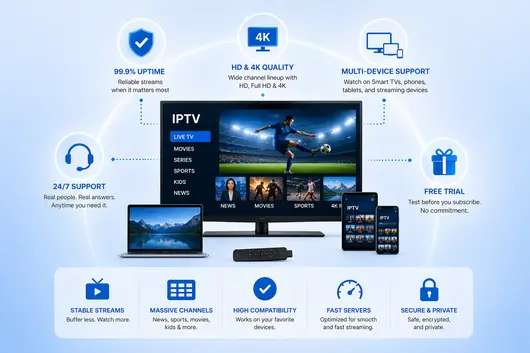
With so many providers available, a short checklist of what actually matters helps cut through the noise.
Stream stability and uptime. A service that drops out during a big game is not worth paying for. Look for providers that commit to 99.9% uptime and back that up with transparent performance records.
Channel variety and video quality. For US viewers, a solid lineup should include local broadcast networks, major news and sports channels, regional sports networks, and a good international selection. HD should be the baseline, with 4K available for supported content.
Multi-device support. Most households stream on more than one screen. A good best IPTV subscription in 2026 should support at least three simultaneous connections across Smart TVs, phones, tablets, and streaming sticks.
Responsive customer support. When something goes wrong, you need a real answer quickly. Providers offering 24/7 live chat are the most reliable choice.
Free trial availability. Any provider confident in their service should let you test it before paying. Our service offers a free trial so you can check picture quality, channel selection, and stream stability with zero commitment.
How to Set Up a Secure IPTV Connection with a VPN
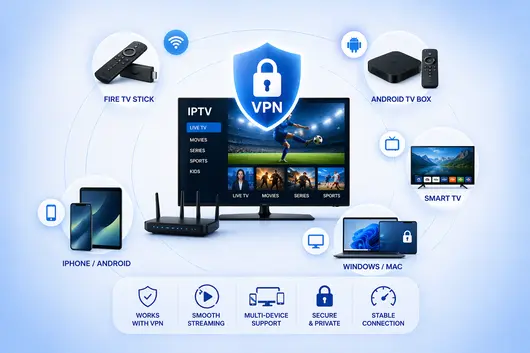
This works for most common US devices and takes less than ten minutes.
Step 1: Choose a trusted IPTV subscription service provider that is transparent about their infrastructure and offers a free trial. This is your foundation.
Step 2: Select a VPN that supports WireGuard, holds a verified no-log certification, and has plenty of US-based servers. Install it on your streaming device.
Step 3: Configure your device.
- Fire TV Stick: Install the VPN app from the Amazon App Store, connect to a US server, then open your IPTV app.
- Android TV box: Follow the same steps through the Google Play Store.
- Smart TV without app support: Configure the VPN directly on your home router to cover every device automatically.
- Phone or tablet: Install both the VPN app and IPTV app, connect the VPN first, then launch the IPTV app.
Step 4: Test before committing. Run a speed test with the VPN active. You need at least 25 Mbps for HD and 50 Mbps for 4K. Load a few channels across different categories to confirm stability and picture quality.
Devices That Support Secure IPTV with VPN in the US
Amazon Fire TV Stick is the most widely used streaming device in the US. It supports both IPTV apps and VPN clients through the Amazon App Store. The 4K Max model handles high-quality streams particularly well.
Android TV boxes offer the most flexibility, with full Android support for virtually any app and system-level VPN configuration.
Smart TVs support IPTV apps natively or through sideloading. If your TV does not support VPN apps directly, your router is the most practical alternative.
iPhones, iPads, and Android phones are straightforward and reliable for mobile streaming, with mature VPN and IPTV app support on both platforms.
Windows and Mac computers give you the most control. Desktop VPN software is stable and well-developed, making this the easiest environment for a best secure IPTV setup.
Red Flags to Avoid When Choosing a Provider
No customer support contact. If you cannot reach anyone before subscribing, it will be even harder after. A legitimate IPTV subscription service provider is reachable.
No trial period. Providers who will not let you test the service are often aware of quality problems. A free trial is a basic sign of confidence.
No uptime commitment. Avoiding specific uptime figures is a strong signal about infrastructure reliability.
No mention of VPN compatibility. A provider that does not address VPN use may block it outright or have undisclosed compatibility issues.
Suspiciously low pricing with no transparency. Extremely cheap plans often mean oversaturated servers, poor stream quality, and no meaningful support. Value matters, but rock-bottom pricing with zero transparency is a warning sign.
Frequently Asked Questions
Can I use a VPN with any IPTV service?
Most modern services support VPN use, but it is worth confirming with your provider. Our service is fully compatible with all major VPN providers and works well with WireGuard, OpenVPN, and IKEv2.
Is IPTV legal in the US?
IPTV as a technology is completely legal. What matters is whether the content is properly licensed. A reputable best secure IPTV provider is transparent about their licensing and content rights.
Does a VPN slow down streaming?
With a fast protocol like WireGuard and a nearby server, the impact is usually unnoticeable on connections of 50 Mbps or faster. Speed loss only becomes a real issue with slow or distant servers.
Do you offer a free trial?
Yes. Afree trial is available so you can evaluate stream quality, channel variety, and overall performance before making any payment. It is the most straightforward way to know if the service is right for you.
Finding the best secure IPTV service is not complicated once you know what to look for. Encrypted delivery, a no-log policy, confirmed VPN compatibility, and a provider willing to offer a free trial are the four things that matter most. Everything else follows from there.
A VPN adds the final layer of protection, preventing your ISP from throttling your connection and keeping your viewing habits private. Together, a secure IPTV subscription and a reliable VPN give you a streaming setup that is stable, private, and genuinely built for 2026.
The free trial is the easiest way to see the difference for yourself. No long-term commitment, no pressure. Just clean, private streaming from day one.